![[back]](/assets/home_24dp_E3E3E3_FILL0_wght400_GRAD0_opsz24.svg "[back]")
![[search]](/assets/search_24dp_E3E3E3_FILL0_wght400_GRAD0_opsz24.svg "[search]")
How the Ancient Greeks Built Megalithic Temples
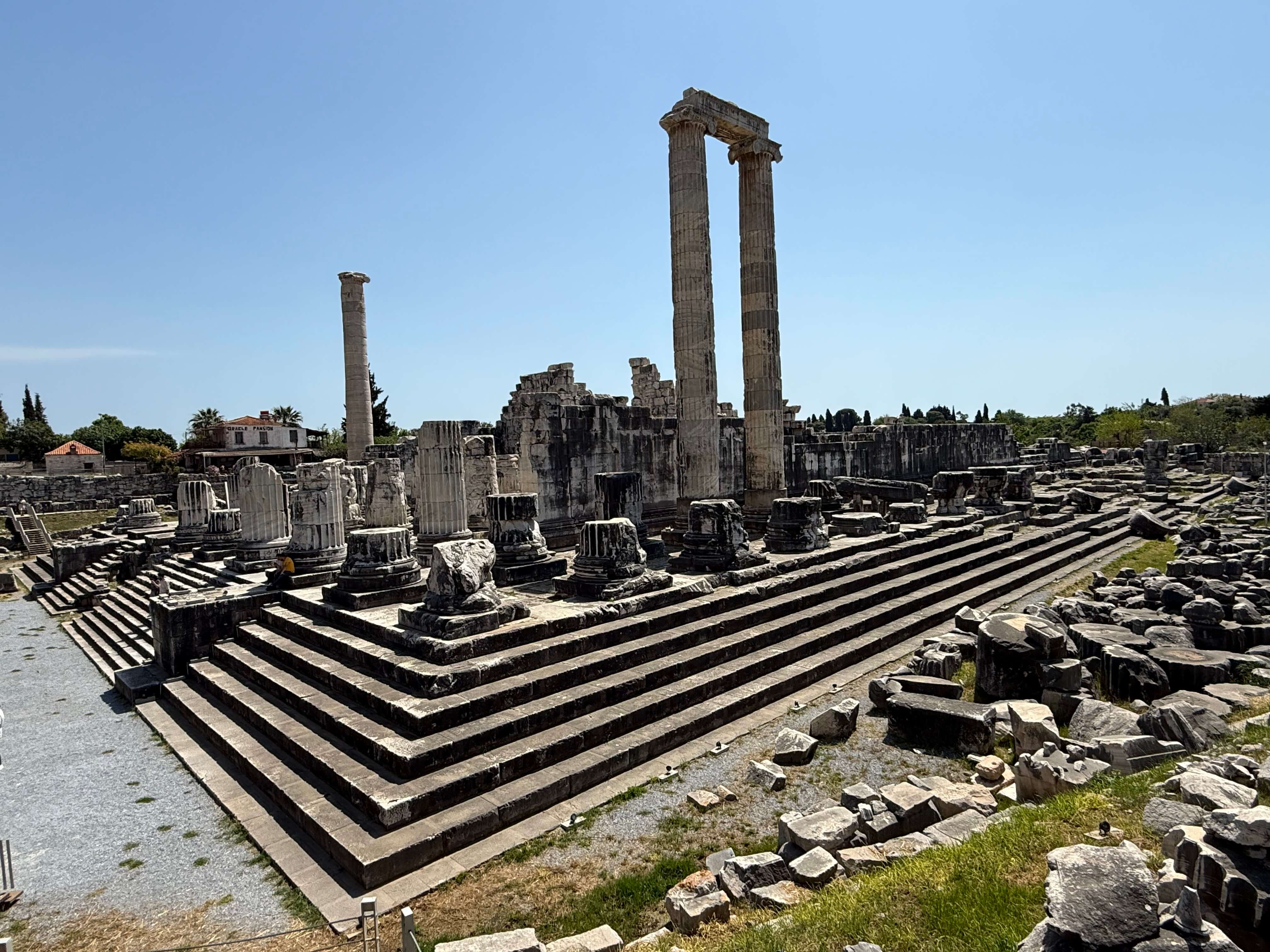
Didyma
- Engineering Stone Without Modern Machines
- The Quarry Was the First Construction Site
- How Did They Cut Stones So Precisely?
- How Were 10-Ton Blocks Transported?
- Raising Stones Into the Air
- Early Methods
- The Greek Crane
- How Did They Attach the Rope?
- Positioning Stones With Millimeter Accuracy
- How Did They Carve Perfect Columns?
- Why Greek Ornament Looks So Consistent
- Did They Have a Lost Technology?
- Ancient Sources
Engineering Stone Without Modern Machines
Visitors to places such as Didyma, Ephesus, Bassae, the Parthenon, or the Temple of Zeus at Olympia often assume that the Ancient Greeks possessed some lost technology. The sheer size of the stones seems almost impossible to reconcile with the tools available before iron cranes, steam engines, or modern hydraulics.
The archaeological evidence, however, points to something even more impressive: the Greeks achieved these monuments through an extraordinary combination of geometry, skilled stoneworking, mechanical engineering, careful planning, and thousands of coordinated hours of labor. Ancient authors such as Vitruvius preserve descriptions of these methods, while unfinished temples—including Didyma itself—still preserve the physical evidence left behind by the builders.
The Quarry Was the First Construction Site
Construction did not begin at the temple.
It began at the quarry.
Greek architects deliberately selected stone based upon its structural properties, ease of carving, appearance, and transportation distance. Pentelic marble supplied Athens, while Didyma largely used local limestone and marble from nearby quarries.
Rather than extracting enormous random blocks, quarry workers planned each architectural member before it was removed. Every column drum, architrave, capital, wall block, and foundation stone was already assigned its future position within the building.
Modern archaeology shows that quarrymen first isolated a block by cutting deep channels around it with iron picks and chisels before driving iron wedges into prepared slots to split the stone cleanly from the bedrock. Only enough excess stone was left to protect finished surfaces during transportation.
This dramatically reduced the amount of unnecessary weight that needed to be moved.
How Did They Cut Stones So Precisely?
Perhaps the greatest mystery is not lifting the stones, but fitting them.
Many Greek temples exhibit joints so fine that a knife blade cannot easily enter between adjacent blocks.
Contrary to popular myth, the Greeks did not machine entire surfaces perfectly flat.
Instead, they used an ingenious technique known today as anathyrosis.
Only a carefully dressed perimeter around each block was finished to exceptional precision. The center of the surface was recessed slightly.
When two stones met:
- only the outer margins actually touched,
- the enormous weight compressed these margins tightly together,
- the recessed interior prevented rocking.
This method greatly reduced the amount of stone that required painstaking finishing while producing joints that appear nearly airtight.
The final fitting was achieved by repeated cycles of lowering, marking high spots with pigment or dust, lifting again, trimming with chisels, and repeating until the stones seated perfectly.
No mortar was required.
The immense weight of the masonry created friction sufficient to stabilize the structure.
The resulting precision is one of the defining characteristics of Classical Greek architecture.
How Were 10-Ton Blocks Transported?
Transportation was often the most expensive stage of construction.
Moving a ten-ton block even a few kilometers required tremendous planning.
Evidence from quarries, roads, inscriptions, and Vitruvius shows several different techniques depending upon the size and shape of the stone.
Smaller blocks traveled on heavy four-wheeled wagons pulled by teams of oxen.
Larger stones often traveled on wooden sledges sliding across prepared roads.
Workers continually reduced friction by using rollers, lubrication, or carefully prepared road surfaces.
Whenever possible, transportation by sea was preferred because water dramatically reduced the required pulling force.
Vitruvius even describes ingenious transport systems for enormous columns in which timber frameworks were built around the shafts, allowing them to rotate like giant wheels rather than being dragged. Similar methods were used for rectangular blocks by constructing wooden frames around the stone itself, transforming the load into a rolling axle. (De Architectura 10.2).
Raising Stones Into the Air
The greatest engineering challenge was lifting.
Temple walls commonly required blocks weighing between 5 and 15 tonnes.
Column drums often exceeded 20 tonnes.
The largest architraves and foundation stones could approach or exceed 80 tonnes.
Different sizes required different solutions.
Early Methods
Before sophisticated cranes became widespread, builders relied upon combinations of:
- earthen ramps,
- timber frameworks,
- ropes,
- wooden rollers,
- levers,
- capstans powered by men or animals.
Recent archaeological work suggests that lifting machinery appeared in Greece earlier than traditionally believed.
Characteristic rope channels cut into seventh-century BCE stone blocks indicate that primitive lifting devices may already have been operating roughly 150 years before the classical Greek crane became standard.
The Greek Crane
By the late sixth century BCE, true cranes had become common.
These consisted of:
- tall wooden masts,
- heavy cross-bracing,
- pulley systems,
- capstans,
- massive hemp ropes,
- wooden winches.
The purpose of the pulley was not merely to change direction.
Compound pulley systems multiplied mechanical advantage.
Although lifting an 80-ton stone with one rope would be impossible, a sufficiently large block-and-tackle system dramatically reduced the force required.
Human operators or teams of oxen slowly rotated capstans, winding rope around large drums while the pulleys multiplied their effort.
Vitruvius later describes several forms of these lifting machines in detail (De Architectura Book X).
How Did They Attach the Rope?
This is one of the most fascinating parts of Greek engineering.
Builders did not simply wrap ropes around finished stones.
Instead they developed several lifting methods.
Rope bosses
Many unfinished blocks at Didyma still preserve projecting stone knobs.
Ropes looped around these temporary bosses.
After final placement the bosses were chiseled away.
Didyma preserves many excellent examples because construction stopped before the finishing stage.
Rope channels
Other stones contain carefully carved grooves.
Ropes could be passed through these channels, allowing workers to lift and precisely position the block before withdrawing the rope.
Recent research argues these grooves likely served both lifting and final positioning.
Lewis holes
Later Greek and especially Roman builders increasingly used the Lewis.
A specially shaped hole was cut into the top of the stone.
An expanding iron clamp locked itself inside the cavity.
The crane lifted directly from the center of gravity, allowing stones to be lowered into remarkably precise positions before the clamp was removed.
Positioning Stones With Millimeter Accuracy
Lifting was only half the problem.
Once suspended, the stone still had to be moved sideways into its final position.
Archaeological evidence shows that workers combined:
- wooden rollers,
- iron or hardwood levers,
- wedges,
- gradual lowering,
- repeated adjustments.
A crane generally brought the block close to its destination.
Levers performed the final millimeters of alignment.
This explains why Greek temples often exhibit astonishing precision despite using entirely manual equipment.
How Did They Carve Perfect Columns?
Perhaps the most surprising evidence survives at Didyma.
Several unfinished columns still preserve the construction process itself.
The columns were not carved freehand.
Instead the builders first marked the entire shaft with precisely measured guide lines.
The width of every flute was laid out before carving began.
The desired depth and profile of each flute were marked at both ends of the column.
Stonecutters could then work toward these reference profiles, ensuring every flute remained identical from top to bottom.
Evidence at Didyma also indicates that full-scale architectural drawings were inscribed directly onto walls within the temple complex itself, functioning as permanent templates for craftsmen.
This approach explains why fluting appears almost mechanically consistent over columns more than ten meters tall.
Rather than relying solely upon artistic judgment, the Greeks employed standardized geometry.
Why Greek Ornament Looks So Consistent
The same principle extended beyond fluting.
Capitals, moldings, cornices, triglyphs, dentils, and decorative profiles all followed geometric templates.
Master craftsmen established the canonical proportions.
Teams of highly trained stonecutters then reproduced these profiles using measuring rods, compasses, templates, plumb lines, squares, and repeated gauge checks.
This resembles the methods still employed today in many traditional Hindu temple workshops, where standardized geometric rules allow hundreds of craftsmen to produce ornament that appears almost machine-made despite being carved entirely by hand.
The remarkable consistency reflects disciplined systems of measurement rather than industrial manufacturing.
Did They Have a Lost Technology?
Nothing presently discovered requires a lost civilization or unknown machines.
Instead, the evidence points toward remarkable engineering using technologies that are individually simple but collectively sophisticated:
- careful quarry planning,
- standardized geometry,
- precision stone dressing,
- anathyrosis joints,
- sledges and heavy wagons,
- timber rollers,
- capstans,
- block-and-tackle pulley systems,
- cranes,
- lifting bosses,
- rope channels,
- Lewis clamps,
- levers for final positioning,
- full-scale architectural templates.
The true achievement of Greek architecture was not miraculous machinery.
It was the organization of thousands of precisely executed operations into a coherent engineering system.
Standing before the unfinished columns of Didyma today, one can still read the builders’ layout lines, unfinished bosses, lifting marks, and guide grooves. They reveal that these monuments were not created by mystery, but by generations of craftsmen whose understanding of geometry, mechanics, and construction rivaled the greatest builders in history.
Ancient Sources
- Vitruvius — De Architectura Book X (transport devices, cranes, pulleys, lifting machines)
- Hero of Alexandria — Mechanica (later development of cranes and pulley systems)
- Pliny the Elder — Natural History Book 36 (quarrying and monumental construction)
Modern Sources
- J. J. Coulton, Lifting in Early Greek Architecture (1974). (Cambridge University Press & Assessment)
- Alessandro Pierattini, Interpreting Rope Channels: Lifting, Setting and the Birth of Greek Monumental Architecture (2019). (Cambridge University Press & Assessment)
- University of Notre Dame, summary of Pierattini’s research on early Greek lifting technology. (Notre Dame News)
- Hellenic Ministry of Culture, Constructing the Temple. (Ancient Temple)